
Is The Mosquito Bowl a True Story? Only 1 of the 4 Survived
Yes, The Mosquito Bowl is a true story. On Christmas Eve 1944, two regiments of the 6th Marine Division played a real football game on Guadalcanal, and three months later 15 of the 65 men who played it were killed on Okinawa. Of the four players Netflix’s movie follows, only one came home.
Peter Berg’s film streams on Netflix Nov. 25, and it does change some of the history. Here’s what happened to the real men, who plays each of them, and which big scenes Berg made up.
What was the real Mosquito Bowl?
It was a full-contact game between the 4th and 29th Marine Regiments, played on Dec. 24, 1944, on a parade ground of dirt and broken coral. The two regiments had spent months arguing over beer about which one had the better former college players. The division’s commander, Maj. Gen. Lemuel Shepherd, approved the game to lift morale before Okinawa.
The talent was absurd for a scrimmage. According to TIME, the rosters held three All-Americans, seven former college captains and close to 20 men who had been drafted by NFL teams or would go on to play in the league. The Marines built their own goalposts, printed programs and broadcast the game over the Mosquito Network, the Armed Forces Radio station named for the island’s insects.
It was supposed to be touch football. It wasn’t for long. The final score was 0 to 0.
Who survived The Mosquito Bowl? The four real Marines
The movie is built around John McLaughry, Bob Bauman, Tony Butkovich and Dave Schreiner. Author Buzz Bissinger has said he picked those four partly because their families kept the most letters and records.
| Real Marine | Played by | Before the war | What happened |
|---|---|---|---|
| Tony Butkovich | Ray Nicholson | Purdue fullback, Cleveland Rams first-round pick in 1944 | Killed April 18, 1945, on Okinawa, age 24 |
| Bob Bauman | Bill Skarsgård | Wisconsin tackle from Harvey, Illinois | Killed June 6, 1945, leading Company A of the 4th Marines |
| Dave Schreiner | Tom Francis | Two-time All-American at Wisconsin, Big Ten MVP in 1942 | Mortally wounded on patrol June 20, 1945, died June 21 |
| John McLaughry | Nicholas Galitzine | Brown captain under his father, then a season with the New York Giants | Survived and lived to 90 |
Tony Butkovich
Butkovich was the son of Croatian immigrants from a coal town in central Illinois. In 1943 he rushed for 833 yards in seven games for an undefeated Purdue team, then got called away by the Marines before the season ended. TIME reports he cried in the locker room over having to leave.
He was the first of the four to die, killed during the push through northern Okinawa after less than three weeks on the island. Pro Football Archives and the University of Illinois Alumni Association both give the date as April 18. One military records site lists April 16.
Bob Bauman and Dave Schreiner
Bauman and Schreiner were Wisconsin teammates and best friends, and they ended up in the same company. Bauman was the loose one. Schreiner was the worrier, and Bissinger quotes Bauman’s advice to him as a single line: “Dave, don’t overthink, Dave.”
Bauman was wounded in April, went back to the front and was killed on June 6 by machine gun fire on the Oroku Peninsula. Schreiner was hit on patrol two weeks later, as the battle was ending, and died June 21. Accounts of how he was hit still disagree. Some say a sniper, others grenade fragments or Japanese soldiers who appeared to surrender and then opened fire.
John McLaughry
McLaughry was the oldest and the only one already out of college. He fought through all of Okinawa, came home to his wife, raised three children and coached football at three colleges, the last of them Brown. He also kept painting. In 1993 he wrote down what he remembered of the day Schreiner was hit.
George Murphy, the fifth man you’ll notice
Broadway actor Brent Comer plays George Murphy, the former Notre Dame captain who played in the game for the 29th. He was killed in mid-May 1945 on Sugar Loaf Hill, three days before the Marines finally held it, after stopping to help a wounded man while bringing his platoon down.
What The Mosquito Bowl movie changes from the true story
Quite a bit, and the people who made it say so openly.
- The movie puts all four men in one regiment. In reality, Schreiner, Bauman and McLaughry were officers in the 4th Marines, and Butkovich was in the 29th, so he played on the other side of the field.
- The long battle at Tarawa, the November 1943 assault on a Pacific atoll, didn’t happen to any of them. None of the four fought there. Berg told TIME that Marines stranded on a reef under fire was the first image he knew the film needed.
- The grudge between Schreiner and Butkovich is invented.
- Dates are compressed so the four share basic training and one path to the Pacific. Variety’s review said the dates are “lightly fudged.”
Bissinger signed off on the changes. “There were some areas in which Pete had to create his own narrative, and that was going to veer from the book,” he told TIME. “But that doesn’t bother me, because the essence was there.”
Is The Mosquito Bowl based on a book?
Yes. It’s adapted from Bissinger’s 2022 nonfiction book, The Mosquito Bowl: A Game of Life and Death in World War II. Bissinger, who won a Pulitzer and wrote Friday Night Lights, has a personal stake: his father was a rifleman in the 4th Marines on Okinawa and never talked about it.
Berg and Bissinger are cousins. This is the second Bissinger book Berg has adapted, after Friday Night Lights in 2004. Berg co-wrote the script with Mark L. Smith and shot the film in Australia, with a sand quarry standing in for the battlefield below Shuri Castle.
How to watch The Mosquito Bowl, runtime and age rating
The Mosquito Bowl streams on Netflix starting Wednesday, Nov. 25, 2026, after a limited theatrical run that began Oct. 30. It runs 2 hours and 7 minutes and is rated R for intense sequences of graphic war violence, grisly images and language throughout. That rating is earned. The Tarawa sequence is long and brutal, so it’s not a pick for younger teens on Thanksgiving weekend.
Critics are split. As of Nov. 24 the film sits at 41% with critics on Rotten Tomatoes and 90% with verified audiences.
My guess is the audience number holds once it hits Netflix. Reviewers mostly fault the thin characters, but the people searching whether it’s a true story are coming for the history, and the real fates of these four men land harder than anything Berg invented. If you’re coming from another Netflix release this month, our guide to The Body cast covers a very different kind of fall show, and 3 Body Problem season 2 is next up on Jan. 14.
The Mosquito Bowl true story FAQ
Who won the real Mosquito Bowl?
Nobody. The 4th and 29th Marines played to a 0 to 0 tie on Guadalcanal on Dec. 24, 1944. Berg has said he isn’t sure what the score is in his own movie.
How many Mosquito Bowl players died in World War II?
Fifteen of the 65 men who played were killed on Okinawa in 1945. For years the count was believed to be 12 until Bissinger’s research confirmed 15. Bissinger has called it the largest number of American athletes ever killed in a single battle.
Did John McLaughry survive Okinawa?
Yes. He was the only one of the movie’s four leads to survive. He coached college football at three schools, finishing at Brown, and lived to 90.
Where was The Mosquito Bowl filmed?
In Australia. The reef landing was shot in heavy surf, and a coastal sand quarry doubled for the Okinawa battlefield near Shuri Castle.
Historical details come from TIME’s report on the real Marines and Netflix’s Tudum, plus Terry Frei’s research on the 15 players killed on Okinawa. Runtime and rating are from Variety and Rotten Tomatoes.
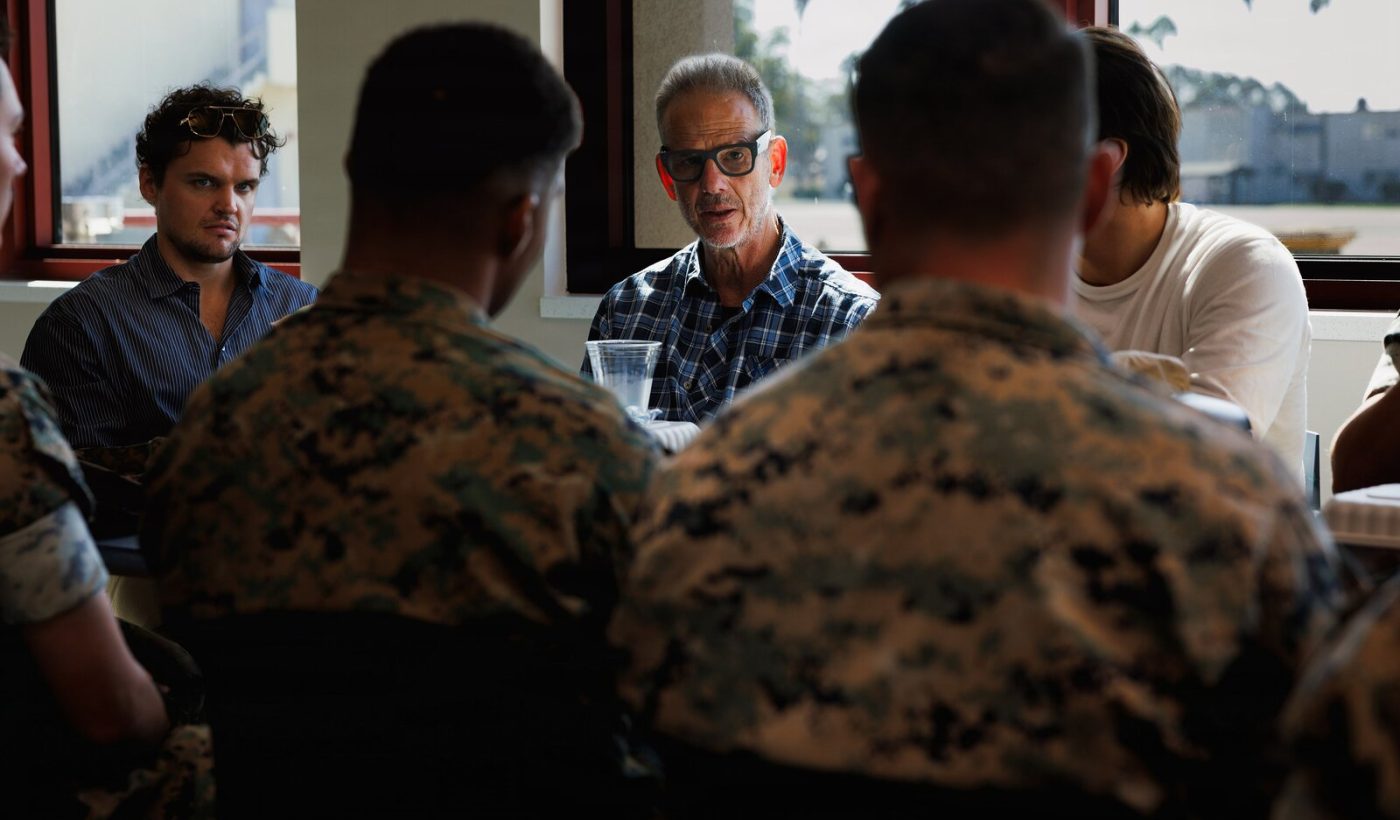
Featured photo: director Peter Berg, center, and Ray Nicholson, left, talk with Marines at Marine Corps Base Camp Pendleton on Oct. 20, 2026, by Sgt. Haley Fourmet Gustavsen, U.S. Marine Corps, public domain via Wikimedia Commons.